Showing posts with label weather. Show all posts

Monday, April 5, 2021

Celebrating Mud

 Guest Post by Julie Hoel, KVR Instructor and Enthusiastic Mud Loving Grandparent

I was just out of college and visiting a friend who had three children. We were chatting when her five-year-old son came bursting in the door full of boyish exuberance and covered with splotches of mud from head to foot. She took one look at him, put on her sternest mom face, whipped out her you’re-in-big-trouble-now voice and said, “JAY MEYER, HAVE YOU BEEN PLAYING IN THAT CREEK?” The smile fell from his face, he rolled his big brown eyes upward and said, “No.” The two older sisters and I tried our best contain our laughter as his mom began peeling off the muddy clothes and throwing them directly into the washer. To her credit, she did not shame him for being a muddy mess but continued with her harangue, “You know you’re not supposed to be playing in that creek!” Clearly, her concern was the danger of water play rather than dirty clothes. 

In these parts, we cannot escape the mud of the March thaw and April showers that follow. We can save ourselves irritation and frustration by just embracing and celebrating the wonders of mud. In that spirit, I would like to share my favorite holiday photo of all time. It was refreshingly different from the typical family photo of the kids clean and pressed. These parents were secure enough to celebrate their kids in all their mischievous muddiness in the deep green of a summer day.  When I recently asked their dad if I could share this image, he said, you’re “welcome to use that pic if it’s to promote kids being kids!” He added, “I think based on where we lived our kids naturally got real dirty experiencing being a kid in nature. We had 50 acres and a half mile of river frontage…what a place to be a kid!” He pointed out the nice clean laundry hanging on the line behind them. I also noticed that they are both wearing glasses that somehow remained relatively clear. Definitely experienced mudballs with some self-control!

In these two vignettes, the children sought and located the mud on their own. A quick google search will bring up many benefits of mud play including development of fine and gross motor skills, increasing cognitive skills and enhancing creativity. It also is good for the immune system and decreases stress levels. We would therefore be wise and wonderful caretakers to seek out opportunities for our children’s mud exploration. My favorite resource, Pinterest, has limitless schemes to bring mud play to every location. There are recipes for mud paint, fizzing mud and mud soup. The design suggestions for mud kitchens are endless.

But the fun of mud play is not just for children. Back in ’93, I experienced mud as art with adults during a volunteer week at Dr. Patch Adams’ Gesundheit! Institute in West Virginia. His model of good health includes humor and art as healing. Once a week, volunteers were encouraged to experience community in the mud pit. After the mud bath, there were photo sessions of numerous statuesque poses. It was a truly memorable experience!

So when you encounter the inevitable mud of the season, I encourage you remember your own fondest muddy memory and smile.  And if a mud-covered child comes bursting in your doorway, greet them with that smile and make throwing those dirty clothes into the washer a celebration.

P.S. All the above references to mud exclude flood mud.  That nasty stuff is a nightmare.

For some more muddy inspiration, check out these books and links:


 Mud by Mary Lyn Ray, Illustrated by Lauren Stringer

This beautiful book celebrates the beginning of the mud season in simple text and gorgeous illustrations. 


Mudplay for Kids: Why It's Worth the Mess - Healthline This article provides details about why messy play is so beneficial for children.

Mud, Marvelous Mud - Community Playthings With the benefits clearly outlined, this article provides ideas and considerations for embracing mud play with your child.

Monday, March 8, 2021

Looking for Spring

  C. Chybowski

A guest post by KVR Educator Cathy Chybowski

Spring is in the air!  Even if the calendar says “March,” the cold winds blow, and the snow lingers, those of us tuned in to the changing seasons know that spring is fast approaching. By observing and recording natural events year after year, we can accurately predict and anticipate the sequence in which these events occur. 

The study of recurring natural events like the migration of birds or the flowering of plants and their connection with each other as the seasons change is called phenology.

Everyone practices phenology whether they realize it or not—naturalists, gardeners, farmers, and homeowners, among others. “April showers bring May flowers” is pure phenology.

Islay Pictures Photoblog

What tells you that spring has arrived? Is it the first robin of the year? Like Aldo Leopold, many people sense that spring has sprung when they see and hear a flock of geese flying in the typical V-formation proclaiming the change of season. 

 “One swallow does not make a summer, but one skein of geese, cleaving the murk of a March thaw, is the spring.”          

Leopold continues .  .  .  .  “A cardinal whistling spring to a thaw but later finding himself mistaken, can retrieve his error by resuming his winter silence. A chipmunk, emerging for a sunbath but finding a blizzard, has only to go back to bed.  But a migrating goose, staking two hundred miles of black night on the chance of finding a hole in the lake, has no easy chance for retreat. His arrival carries the conviction of a prophet who has burned his bridges.”

     Greg Gillson

 Sid Hamm

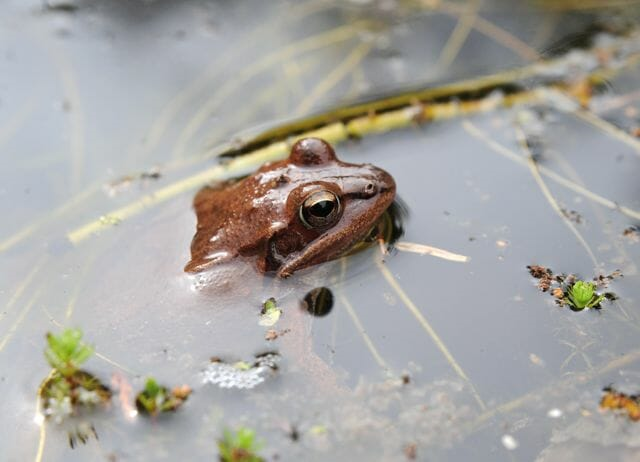
It is time to check last year’s phenology records for the order of events. We can predict that in southern Wisconsin, the red-winged blackbirds return to the marshes before the end of February and the bluebirds return to nest by March 15. The wood frogs begin their choral courtship the third week in March and ground squirrels and woodchucks emerge sleepy from hibernation by the end of March.  Hepatica begins to bloom around mid-April  and bloodroot blooms about one week later.

                                                                                                                                     awaytothgarden.com
                 C. Chybowski

Nature’s grand production runs from the time that skunk cabbage pokes up through the snow, through the time when the woodpeckers begin to drum, male red-wings “onk-la-ree” from the cattails and pussy willows fluff out. Killdeer and meadowlarks return, chipmunks awaken from their winter dormancy, song sparrows sing “hip hip hooray guys, spring is here,” balls of garter snakes appear, painted turtles pop up on sunning logs, mourning cloak butterflies and little brown bats flit about, and spring ephemerals emerge from the woodland floor.

   V. Charney

All of these observations were made before April 15th.  Soon thereafter the great wave of warbler migration begins (about a month after the woodcocks begin their aerial courtship display). Then the tree leaves burst forth, flowers in gardens and fields bloom and the air holds the sweet scent of lilacs just in time for Mother’s Day. The show continues on and on . . .

“During every week from April to September there are on average, ten wild plants coming into first bloom. . . No man can heed all of these anniversaries; no man can ignore all of them.”                                                                                                                                                       -   Aldo Leopold

No two years are exactly the same and some signs of spring are more reliable than others. Frogs are good predictors of spring. Wood frogs and spring peepers begin to sing soon after ice-out when the water has warmed to 46 degrees F. Earthworm castings become visible when the frost has come out of the ground. The return of robins and bluebirds is not a reliable indicator of spring because some of them stay in our area throughout the winter.

                                         petponder.com
            
Spring usually invades our state in the southwest corner and marches north and northeast at a rate of about fifteen miles a day. This was determined when residents across the state were asked to record the date at which the lilac, a species familiar to everyone, was in peak flower.

According to Hopkin’s law, phenological events vary at the rate of one day for each fifteen minutes of latitude, 1.25 days for each degree of longitude, and one day for each one hundred feet of altitude, being later northward, eastward, and upward. When applied in Wisconsin, this law seems to hold almost exactly along a north-south axis; except that Lake Michigan retards the spring warmup.

Above is merely a sampling of the discoveries that await the curious nature observer. It is a fun time of year for each of us to get outside and take a closer look at what Aldo Leopold calls the “hundred little dramas” happening right outside the door when spring is in the air. 

Monday, December 14, 2020

Weatherproofing Children (and Their Adults!) for Winter


Last week we posted about great local options folks have for winter activities. Part of getting geared up for winter is shifting our mindsets and being prepared. Norwegians have a term that's useful in considering weather-hardiness. It's friluftsliv, which means "free outdoor life." In Norway, there's a saying about there not being any bad weather...only bad clothes! 

So as the temperature drops and snowflakes begin to fly, we have some tips and ideas for not only getting your children ready to embrace winter's wonders, but for you, too.

Kickapoo Valley Forest School Leadership Team members Julia Buckingham and Ximena Puig recently led a virtual roundtable focused on winter and weather resiliency. Their presentation included the following great tips we'd like to share. Forest school students and their families will gain lots of experience in embracing all kinds of weather, and the guidelines we have for them work for everyone.

Embrace wonder.
Children absorb adults' energy and attitudes toward just about everything, and the weather is no exception. Be aware of how you talk about the weather and consider being open to the beauty of cold, the way the landscape changes, and the challenge of getting out to explore. Your excitement and wonder can spark the same enthusiasm in children, and this is an important aspect of developing winter resilience.


Dress in layers.
We can't stress this enough. Trapping heat in a base layer and middle layer can make a huge difference in comfort. Selecting an outer layer that repels water and wind is essential. You can always remove a layer, but adding one is difficult once you are out and about. Dressing appropriately helps children really explore without worry over getting wet and cold, and it can help you stay out longer if you've brought along snacks and a bottle of water. 


Wool is your friend.
Naturally moisture-absorbing and lightweight for it's warmth, wool is a great layer. For those who are allergic to wool, there are many alternatives made of synthetic materials or silk. 

Create systems for caring for outdoor gear.
Be sure to make a plan for drying your outdoor gear, hanging it for next time, and dealing with the puddles, mud, and mess that is an inevitable part of coming in from the outdoors. Involving your children by having reachable hooks and spots for muddy boots makes learning to take care of our gear part of the whole process of enjoying the outdoors. 

Julia and Ximena also shared great ideas for some activities you can do outdoors this winter including gathering treasure for ice suncatchers, making pinecone bird feeders, and telling stories based on animal tracks. 


There was a great recent feature on NPR about weatherizing ourselves for winter. Interspersed with fantastic cartoons by LA Johnson about dressing like an onion and eating snacks rich in fat, calories, and protein (yay!), this article and accompanying audio has some excellent tips for adults as we embrace this new season. 

When you come inside, don't forget to read books together about winter life and adventures to inspire your next outdoor day. Here's a list of 100 picture books to read with children. 

Wishing you a wonderful winter season!

Friday, May 29, 2020

Everyday Weather

Every morning when she wakes up my youngest asks me, "What's it going to be like today?"  She isn't asking about our plans for the day, or what our moods will be, she is asking about the weather.  She wants to know details:  What will the temperatures be like? Will it rain? Will it snow?  She uses this information, like many of us, to plan her day.  Will she bike in the rain and let the puddles throw stripes up her back?  Will she get to use her umbrella?  Will it be hot enough to run in the sprinkler?  Will she venture into the cool damp of the forest to look for mushrooms? Will she lay on her back and watch the clouds go by? Will it be windy enough to fly a kite? And what clothes should she put on to be ready to play outside today?

Tuning into the weather is an important skill for children.  Paying attention each day to the variations in weather patterns teaches kids strong observations skills.  The weather provides facts that are measurable and leads children to develop questioning and examining abilities that are important in learning the scientific method process. As children pay attention to the weather they are collecting data, evaluating, analyzing and communicating.  They are becoming critical thinkers and scientists!

Here are a few fun ways to help your children investigate changes, observe patterns and file away information about the weather.

  • Create a wind vane with a pencil and drinking straw, then talk about what directions the wind comes from and how it feels when weather comes from the west versus the east.
    https://www.pbs.org/parents/crafts-and-experiments/where-is-the-wind-going-try-a-diy-weather-vane  Blow bubbles outside and follow them, noting the direction they move.
  • Lie on your back and look up at the clouds, describe them.  Which way are they moving and why?  Find a field guide to weather and clouds in your library or go online to learn more about cloud shapes.  
  • Create a weather watch worksheet.  Help your child study and then predict the weather based on the data they collect.  Talk about how the weather affects many people who work outdoors (farmers, construction workers etc.)  You can print a simple worksheet here:  https://www.storey.com/wp-content/uploads/2016/02/NatureConnect_pg55.pdf
  • Do some rainfall experiments.  Set out several different containers- tall and deep, wide and shallow.  See how much rain has collected after a storm.  Check early in the morning to see if dew has collected.  Keep a record of the water level from week to week.  Talk about evaporation.  Do you see insects or animals using the containers for drinking or bathing?
  • Fly a kite.  Ahead of time, make predictions abut how well the kite will fly and in what direction based on observations of wind speed and direction, then test your hypothesis!
Here are some favorite books about weather to read with your children:
The Cloud Book by Tomie De Paola
Worm Weather by Jean Taft and Matt Hunt
It Looked Like Spilt Milk by Charles Green Shaw
The Storm by Akiko Miyakoshi

If you are looking for more weather activity ideas, a favorite resource book we use at the KVR is The Wild Weather Book: Loads of Things to do Outdoors in Rain,  Wind and Snow by Fiona Danks and Jo Schofield.

We'd love to see photos of you and your children enjoying all sorts of weather, feel free to post them to our Facebook page.