Showing posts with label phenology. Show all posts

Monday, March 8, 2021

Looking for Spring

  C. Chybowski

A guest post by KVR Educator Cathy Chybowski

Spring is in the air!  Even if the calendar says “March,” the cold winds blow, and the snow lingers, those of us tuned in to the changing seasons know that spring is fast approaching. By observing and recording natural events year after year, we can accurately predict and anticipate the sequence in which these events occur. 

The study of recurring natural events like the migration of birds or the flowering of plants and their connection with each other as the seasons change is called phenology.

Everyone practices phenology whether they realize it or not—naturalists, gardeners, farmers, and homeowners, among others. “April showers bring May flowers” is pure phenology.

Islay Pictures Photoblog

What tells you that spring has arrived? Is it the first robin of the year? Like Aldo Leopold, many people sense that spring has sprung when they see and hear a flock of geese flying in the typical V-formation proclaiming the change of season. 

 “One swallow does not make a summer, but one skein of geese, cleaving the murk of a March thaw, is the spring.”          

Leopold continues .  .  .  .  “A cardinal whistling spring to a thaw but later finding himself mistaken, can retrieve his error by resuming his winter silence. A chipmunk, emerging for a sunbath but finding a blizzard, has only to go back to bed.  But a migrating goose, staking two hundred miles of black night on the chance of finding a hole in the lake, has no easy chance for retreat. His arrival carries the conviction of a prophet who has burned his bridges.”

     Greg Gillson

 Sid Hamm

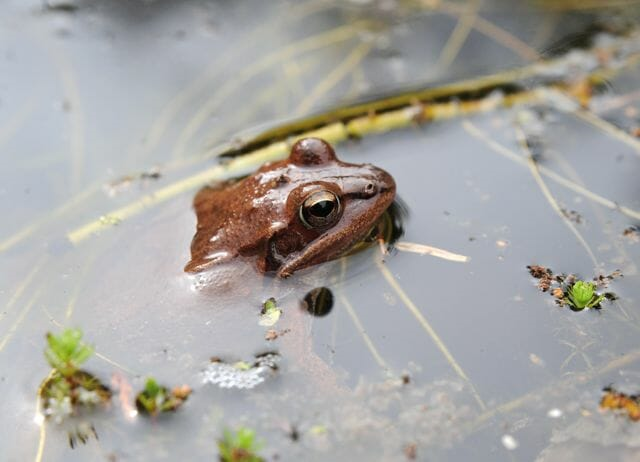
It is time to check last year’s phenology records for the order of events. We can predict that in southern Wisconsin, the red-winged blackbirds return to the marshes before the end of February and the bluebirds return to nest by March 15. The wood frogs begin their choral courtship the third week in March and ground squirrels and woodchucks emerge sleepy from hibernation by the end of March.  Hepatica begins to bloom around mid-April  and bloodroot blooms about one week later.
                                                                                                                                     awaytothgarden.com
                 C. Chybowski

Nature’s grand production runs from the time that skunk cabbage pokes up through the snow, through the time when the woodpeckers begin to drum, male red-wings “onk-la-ree” from the cattails and pussy willows fluff out. Killdeer and meadowlarks return, chipmunks awaken from their winter dormancy, song sparrows sing “hip hip hooray guys, spring is here,” balls of garter snakes appear, painted turtles pop up on sunning logs, mourning cloak butterflies and little brown bats flit about, and spring ephemerals emerge from the woodland floor.

   V. Charney

All of these observations were made before April 15th.  Soon thereafter the great wave of warbler migration begins (about a month after the woodcocks begin their aerial courtship display). Then the tree leaves burst forth, flowers in gardens and fields bloom and the air holds the sweet scent of lilacs just in time for Mother’s Day. The show continues on and on . . .

“During every week from April to September there are on average, ten wild plants coming into first bloom. . . No man can heed all of these anniversaries; no man can ignore all of them.”                                                                                                                                                       -   Aldo Leopold

No two years are exactly the same and some signs of spring are more reliable than others. Frogs are good predictors of spring. Wood frogs and spring peepers begin to sing soon after ice-out when the water has warmed to 46 degrees F. Earthworm castings become visible when the frost has come out of the ground. The return of robins and bluebirds is not a reliable indicator of spring because some of them stay in our area throughout the winter.

                                         petponder.com
            
Spring usually invades our state in the southwest corner and marches north and northeast at a rate of about fifteen miles a day. This was determined when residents across the state were asked to record the date at which the lilac, a species familiar to everyone, was in peak flower.

According to Hopkin’s law, phenological events vary at the rate of one day for each fifteen minutes of latitude, 1.25 days for each degree of longitude, and one day for each one hundred feet of altitude, being later northward, eastward, and upward. When applied in Wisconsin, this law seems to hold almost exactly along a north-south axis; except that Lake Michigan retards the spring warmup.

Above is merely a sampling of the discoveries that await the curious nature observer. It is a fun time of year for each of us to get outside and take a closer look at what Aldo Leopold calls the “hundred little dramas” happening right outside the door when spring is in the air. 

Monday, November 30, 2020

Tuning In and Keeping Track: An Introduction to Phenology


Can you recall the last morning that wasn't filled with birdsong? Do you remember when you first noticed the buds emerging on maple trees in your neighborhood? Which day in April did your ears perk up to hear the spring peepers? When was the very first snowfall last year?

If you find yourself noticing, contemplating, and wondering about the subtle shifts and patterns in seasonal happenings, phenology is your friend. There is comfort in marking time and tuning into our natural environment, especially in turbulent times like these, and phenology can offer a great way to do so. 

Phenology is a fancy term that means the study of cycles and seasonal natural events. The word is built of two parts: "pheno" (phaino in Greek), which means "to show, to bring to light, to make to appear" and "-logy" of the root "logos," which means "study, discourse, or reasoning." It was first used in a public lecture in Brussels by Belgian botanist Charles François Antoine Morren in 1849.

However, phenological understandings have been fundamental to the human relationship with the land and environment. Indigenous peoples have used phenological knowledge in cultural, agricultural, and ecological practices for thousands of years. Here in
 Wisconsin, the College of Menominee Nation has recently created a Phenology Learning Path to honor the ways the Menominee have used nature's calendar to mark time and continue to track climate change impacts. 

In other locations, large scale changes over time have been tracked like in the Royal Meteorological Society's project that spanned 58 years of tracking of temperature and flowering events across the British Isles via 600 individual collectors from 1891-1948. Currently there are several networks collecting data via mostly volunteers in many countries, contributing to the understanding of climate change. The USA National Phenology Network (USA-NPN) maintains a database of observations collected by over 5,000 people who logged information on over 20,000 organisms and over 15,000 plants in 2020. It's fascinating to scroll through the lists of top animals and plants observed, and other information collected like initial growth in plants and migrating behavior. This information is referred to as phenophase data. For folks who enjoy diving deeply into data and data visualizations, this website has an amazing data visualization tool. 


For those of us who might appreciate a less formal approach, phenology in your own local habitat can be greatly rewarding. It can also be a fun activity to do with children. Start small and manageable, and you might be surprised at where this activity will take you in observing natural phenomena.

Here are some ideas to get started:

1. Choose something to observe that's personally interesting and readily available. It could be a bird species that visits your yard, a favorite tree, or a corner of the park with plants.

2. Set a plan to observe at least once a week. Daily would be ideal, but weekly observations will give you a great view of changes.

3. Find out a little more about the thing(s) you have chosen to observe. Species identification is a great first step, and if you can't figure it out by an internet search, reach out to a local naturalist as they love answering questions and sharing information.

4. Create a space to log your observations. This could be a file on your computer or phone, a simple notebook, or a blank calendar square. 5-year journals are easy to create using a template like this and a sturdy 2-inch, 3-ring binder. Since this calendar is organized by day, by the end of 5 years it allows users to see at a glance what was happening on that same date each year. 


5. Record your observations and some details about the weather or other important conditions you notice like time of day, activities around your focused area, and any changes you notice. If you have time or the ability to photograph or sketch your observation, this can add to your record.

6. Consider joining with others to share observations. The Nature's Notebook website hosted by the USA-NPN has several campaigns including monitoring bats, pollinators, and pests. Individual data is personally meaningful, but sharing it as a citizen scientist has the potential to create a volume of data that is relevant in tracking change over time. 


We are all phenologists to varying degrees in our own lives, noticing subtle changes across time in ourselves and in our environment. In a time where so much has changed and shifted in sudden ways, tuning our focus to the rhythms and patterns of the natural world can offer a steadying respite. The simple practices of phenology might provide new, welcoming, and interesting insights in the year ahead.