Showing posts with label birds. Show all posts

Wednesday, May 5, 2021

Creating Wild Spaces Close to Home


It's mowing season again, and a question for those of us who care about wild things might be hovering in our minds: How can we encourage more native plants in our landscapes?

Our readers most likely already see the value of biodiversity, wild places, and honoring native species, but there are so many other issues associated with the American love of standard green lawns. Did you know that over $35 billion is spent annually on lawn care and maintenance in the U.S.? Herbicides and pesticides are still all too common in caring for patches of grass that are not native to the landscape. These chemicals have an impact on the soil and the organisms that depend upon it. It is estimated that 40 million acres of the lower 48 states are lawns!

In our last blog post, we featured important women in Wisconsin conservation. One person that bridges our last post with this one is Lori Otto. In addition to helping combat the use of DDT, a pesticide that is a carcinogen with detrimental impacts to fish, birds, and other wildlife, Otto discovered that allowing her yard to grow more naturally created an excellent habitat for birds and other pollinators. She was active in bringing the "rewilding" movement to American yard owners. Otto's group of natural lawn enthusiasts eventually became the national nonprofit organization, Wild Ones. In January of 2021, Wild Ones released free garden plans for a variety of regions in the United States. 

If you are ready to plan to return your lawn or part of your yard to more native plants, another great resource is the National Wildlife Foundation's Native Plant Finder. You can enter your zip code and find plants ranked by points in terms of how many other species they support. For example, oak trees are listed as potentially supporting 389 species. The tool narrows it down to 15 of the most common caterpillars in our area that rely on oak trees in their life cycle. The Plant Finder Tool would be a great resource to use with children to consider which butterflies you might attract to your yard. Take your list to a nursery that stocks native plants and talk with a plant expert about what might work best in your yard. 

Doug Tallamy, an entomologist with the University of Delaware and author of Nature's Best Hope: A New Approach to Conservation that Starts in Your Backyard, has created the Homegrown National Park Project with a goal of encouraging 20 million acres of native plantings across the U.S. This website has a ton of resources for just getting started in diversifying your backyard, including an article on five easy steps for beginners.  

Here's a talk Doug gave with the National Wildlife Foundation on the principles behind diversifying our landscapes.


It takes learning, commitment, and labor to rewild a patch of yard, but the impact could be great. Less mowing and supporting biodiversity in your own space at the same time are two potential benefits. And if you notice a yard that looks a little more wild than the stereotypical American lawn consider all ways it might be supporting important species.

Urban planners and city dwellers are beginning to reconsider how common greenspaces can be redesigned to include more native species and less manicured lawns. These efforts are helping to sequester carbon, reduce the amounts of pesticides and chemicals in high traffic areas, and connect people with wild things. What's happening in your neighborhood? 

Monday, March 22, 2021

Spring Migration is Upon Us

 Guest Post by Barbara Duerksen

What a delight to welcome back the birds we have not seen for months! There’s music in the air – honking geese and calling swans flying to the northwest, robins, blackbirds, and cardinals singing in the morning, and the loud, rattling bugle calls of Sandhill Cranes.

Sandhill Crane photo by Dave Franks

When the ice goes out, the ducks come in. They might stay for a day, sometimes longer, as they make their journey from the southern states to their nesting territories.  A few of the duck species like Wood Ducks, Blue-winged Teal, and Mallards, stay in our area to raise their broods, while most of the other ducks head for farther north wetlands.  I find Hooded Mergansers particularly elegant and fun to watch. The males are black on top with white stripes in front and back, brown sides, and a black and white head that looks very large when the crest feathers are raised.  Females are brown and also have crest feathers that can be raised or lowered.  They look a little less elegant and more like a bad hair day.  I have found Hooded Mergansers in the Kickapoo Valley Reserve in early spring swimming in the wooded wetland at the junction of Hwy 131 and County P.

Hooded Merganser photo by Jack Bartholmai

Migration is all about food.  Waterfowl need open water to find fish, snails, worms, roots and other plant food.  Insect eaters need warm enough temperatures to find a good steady supply of insects, and that takes them far south of Wisconsin.  Seed eaters and some of the predatory birds can find enough food to get through the winter season, so we’ll see jays, chickadees, cardinals, crows, Cooper’s and Red-tailed Hawks all winter.  Juncos, American Tree Sparrows, Purple Finches, Rough-legged Hawks, and Northern Shrikes are among the species that come from way north to stay here for the winter.  They will be leaving soon, and instead we’ll see Fox, White-throated, and White-crowned Sparrows on their way north, in addition to other early migrants like kinglets and phoebes.

April brings some notable insect eaters, despite the possibility of cold weather and snowstorms. Hermit Thrushes, Yellow-rumped Warblers, and Winter Wrens are all insect eaters that seem to be able to withstand colder temperatures than others of their kind.  Their diets ae a bit more flexible –they prefer insects, but all three are able to digest fruits like juniper berries.  Cold spells with deep snow that last too long can be life-threatening to these birds, as we witnessed with in April, 2018.

Winter Wren photo by Dan Jackson

Winter Wrens are small brown birds with very short tails that they often hold upright.  They are smaller than the more familiar House Wrens that spend their summers here, and most of them fly farther north to the forests of northern Wisconsin and Canada. Winter Wrens have nested in cool microclimates in the Kickapoo Reserve and the Baraboo Hills, preferring areas with coarse woody debris or tangled roots. Some older field guides recommend looking for migrating Winter Wrens in stacks of firewood in the yard. On nesting territory, the male sings a loud, rich, lengthy, bubbly song.  You can listen to the song here by pressing the audio button.

The colorful familiar songsters like grosbeaks, orioles, and Indigo Buntings, will show up a bit later, some in late April and the rest in May, along with many migrating warblers. These are the long-distance migrants that spend the winter in warmer climates, some—Yellow Warblers and Barn Swallows, for example—as far south as countries in South America.

Migration is a perilous journey with hazards that range from bad weather and natural predators, to human-caused habitat destruction, window strikes, poisoning by pesticides, and predation by cats. How to help?  Study up on what birds need, support bird conservation groups and reserves (like the KVR), consider planting bird-friendly plants and trees in your yard.  The Cornell Lab of Ornithology has a list of suggestions here: athttps://www.birds.cornell.edu/home/seven-simple-actions-to-help-birds/

                                            American Woodcock photo by Jack Bartholmai

Ready for an evening adventure?  Go out at dusk to listen for the American Woodcock call and sky dance.  American Woodcocks are in the shorebird family, but nest on the ground in shrubby woodland edges. An odd-looking short-tailed brown bird, they are about robin-size, plump, with long beaks and eyes positioned high up and near the back of the skull. In early spring, the males, looking to attract a mate, find an open area to sit and call a series of single buzzy, nasal “peent” sounds, and after a while, fly up with a twittering sound in a large circle, descend to the same area with a slower chirpy sound, and start again to do the call. This occurs about 20 minutes after sunset. The open area around the Kickapoo Reserve Visitor Center has been a reliable spot to observe this spring ritual of the woodcock. 

For great reading on the woodcock dance check out these favorites:

Aldo Leopold, in A Sand County Almanac, describes the Sky Dance of the woodcocks on his farm in the April section of Part 1.  Frances Hamerstrom, in Walk When the Moon is Full, devotes her April chapter to the story of gong out with her two children to witness the sky dance of the woodcock.

Monday, March 8, 2021

Looking for Spring

  C. Chybowski

A guest post by KVR Educator Cathy Chybowski

Spring is in the air!  Even if the calendar says “March,” the cold winds blow, and the snow lingers, those of us tuned in to the changing seasons know that spring is fast approaching. By observing and recording natural events year after year, we can accurately predict and anticipate the sequence in which these events occur. 

The study of recurring natural events like the migration of birds or the flowering of plants and their connection with each other as the seasons change is called phenology.

Everyone practices phenology whether they realize it or not—naturalists, gardeners, farmers, and homeowners, among others. “April showers bring May flowers” is pure phenology.

Islay Pictures Photoblog

What tells you that spring has arrived? Is it the first robin of the year? Like Aldo Leopold, many people sense that spring has sprung when they see and hear a flock of geese flying in the typical V-formation proclaiming the change of season. 

 “One swallow does not make a summer, but one skein of geese, cleaving the murk of a March thaw, is the spring.”          

Leopold continues .  .  .  .  “A cardinal whistling spring to a thaw but later finding himself mistaken, can retrieve his error by resuming his winter silence. A chipmunk, emerging for a sunbath but finding a blizzard, has only to go back to bed.  But a migrating goose, staking two hundred miles of black night on the chance of finding a hole in the lake, has no easy chance for retreat. His arrival carries the conviction of a prophet who has burned his bridges.”

     Greg Gillson

 Sid Hamm

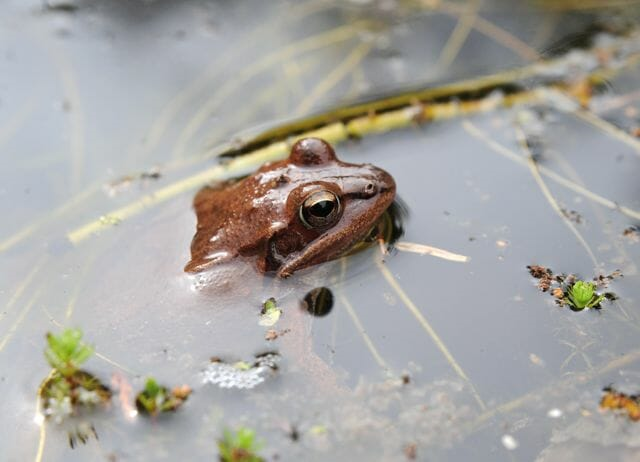
It is time to check last year’s phenology records for the order of events. We can predict that in southern Wisconsin, the red-winged blackbirds return to the marshes before the end of February and the bluebirds return to nest by March 15. The wood frogs begin their choral courtship the third week in March and ground squirrels and woodchucks emerge sleepy from hibernation by the end of March.  Hepatica begins to bloom around mid-April  and bloodroot blooms about one week later.

                                                                                                                                     awaytothgarden.com
                 C. Chybowski

Nature’s grand production runs from the time that skunk cabbage pokes up through the snow, through the time when the woodpeckers begin to drum, male red-wings “onk-la-ree” from the cattails and pussy willows fluff out. Killdeer and meadowlarks return, chipmunks awaken from their winter dormancy, song sparrows sing “hip hip hooray guys, spring is here,” balls of garter snakes appear, painted turtles pop up on sunning logs, mourning cloak butterflies and little brown bats flit about, and spring ephemerals emerge from the woodland floor.

   V. Charney

All of these observations were made before April 15th.  Soon thereafter the great wave of warbler migration begins (about a month after the woodcocks begin their aerial courtship display). Then the tree leaves burst forth, flowers in gardens and fields bloom and the air holds the sweet scent of lilacs just in time for Mother’s Day. The show continues on and on . . .

“During every week from April to September there are on average, ten wild plants coming into first bloom. . . No man can heed all of these anniversaries; no man can ignore all of them.”                                                                                                                                                       -   Aldo Leopold

No two years are exactly the same and some signs of spring are more reliable than others. Frogs are good predictors of spring. Wood frogs and spring peepers begin to sing soon after ice-out when the water has warmed to 46 degrees F. Earthworm castings become visible when the frost has come out of the ground. The return of robins and bluebirds is not a reliable indicator of spring because some of them stay in our area throughout the winter.

                                         petponder.com
            
Spring usually invades our state in the southwest corner and marches north and northeast at a rate of about fifteen miles a day. This was determined when residents across the state were asked to record the date at which the lilac, a species familiar to everyone, was in peak flower.

According to Hopkin’s law, phenological events vary at the rate of one day for each fifteen minutes of latitude, 1.25 days for each degree of longitude, and one day for each one hundred feet of altitude, being later northward, eastward, and upward. When applied in Wisconsin, this law seems to hold almost exactly along a north-south axis; except that Lake Michigan retards the spring warmup.

Above is merely a sampling of the discoveries that await the curious nature observer. It is a fun time of year for each of us to get outside and take a closer look at what Aldo Leopold calls the “hundred little dramas” happening right outside the door when spring is in the air. 

Monday, December 21, 2020

Solstice: Celebrating Winter


Mid-winter or Solstice (December 21) is upon us. Here in Wisconsin the sun is already setting at 4:30pm and not rising again until 7:30am.That's a loooong winter night! Winter Solstice, the time of nature's darkness, has long been celebrated by humans around the world. In Northern climates celebrations often include fire and light to signify welcoming back the sun, and turning toward the renewing days of spring.


While the nights are long, the days of mid-winter in Wisconsin are often sunny and bright.  Taking long walks in the winter sunshine can be rejuvenating and so very interesting. What do you see, hear and find? Where are all the animals and what are they doing to stay warm?  Where do they shelter and what do they eat? How are the trees living through the cold?


To supplement your winter wonderings (and wanderings) you might check out these amazing books. There are some for adults and some for children.

Winter World by Bernd Heinrich
The Longest Night by Marian Dane Bauer
Dear Rebecca, Winter is Here by Jean Craighead George
The Shortest Day by Susan Cooper and Carson Ellis


Indoors there are many ways to continue to observe nature. A favorite is feeding and watching the birds outside your window. Young children can have an up-front seat to bird observation in the comfort of their homes. Many hours can be spent observing the ways that birds use their beaks to eat seeds, how they preen their feathers and how they chase away intruders at the feeder! KVR Instructor Barb Duerksen wrote a great post with tips and reminders about bird feeding back in October.


Collecting bits and pieces of nature and bringing them inside can be another wonderful way to observe and explore winter in the warmth of your home. Create an ever-changing seasonal nature table in your home! For more about creating nature tables, check out The Nature Corner: Celebrating the Year's Cycle with Seasonal Tableaux by M.V. Leeuwen and J. Moeskops.

Stargazing after the sun sets continues to delight during the winter season. Tonight, if the skies are clear from your corner of the world, check out this rare event with Jupiter and Saturn that is happening on solstice. If skies are cloudy in your area, there is a livestream available on the link. KVR Instructor and Astroeducator John Heasley also wrote about Winter Solstice Great Conjunction here. 

***

The Learning Outside blog will take a break until the week of January 11, 2021. We wish our readers everywhere opportunities to notice and appreciate the light of the new season. Thank you for joining us in 2020.


Monday, October 26, 2020

Fall Bird Migration: Sighting, Care and Feeding

 Guest post by Barb Duerksen, KVR Instructor 

Ruby-crowned Kinglet. Photo by Jack Bartholmai.

It’s fall and birds are on the move. Cold weather means fewer insects, so the birds that depend entirely on insects for staying alive must migrate–they fly south to find enough to eat.

October and November are exciting months for people who enjoy seeing birds that are flying in from farther north. Some are species that we can find only during the time of migration. 

The Ruby-crowned Kinglet is a migrant that I’ve seen along the roadsides recently. They are olive-colored with white wing bars and a white eye ring. They are small and energetic, flying quickly through the shrubs, weeds, and trees, searching for food and flicking their wings almost constantly. In fall the kinglets are quiet, except for a soft two-noted “jidit” call. The ruby-colored spot on top of the male’s head is usually hidden in fall. When they come back through in the spring, the males display that bright red spot, and sing a sweet warbly song. (Listen to the song and call here by clicking on the Audio button.) Most Kinglets will be gone by the end of October. They will spend the winter in the southern United States and Mexico.


Tundra Swan. Photo by Dan Jackson.

Waterbirds are another group of birds that migrate. They live on or near water, so when it gets cold enough for the water to freeze, they fly south to warmer places. Late October through November is a good time to find geese, swans, and many different species of ducks on ponds and rivers. Tundra Swans are huge white birds with long necks that nest in the far north Arctic tundra. When the weather turns cold, many of them fly south and east, some stopping at resting places like the Mississippi River for a time while they tank up for the rest of the flight. Many spend the winter in the Chesapeake Bay area on the east coast. Goose Island and south along the Mississippi River are good places to find hundreds of these swans in November and sometimes into early December, depending on when freezing temperatures arrive. They call constantly during migration, a high musical “hoo hoo” sound. When you hear that, look up, and you’ll see a flock of big white birds heading south east. Sometimes they migrate at night. (Listen to their call here by pressing the Audio button.)


Dark-eyed Junco. Photo by Dan Jackson.

The birds that can stay alive eating seeds don’t need to leave when the insects disappear. They can usually find food all winter. These birds stay here year-round and are appropriately called resident birds. Black-capped Chickadees, White-breasted Nuthatches, cardinals, Blue Jays, goldfinches, some sparrows, and many of the woodpeckers are residents who stay here through the winter. Some birds like Dark-eyed Juncos and Purple Finches fly here from the north and stay for the winter. Putting up a bird feeder in the yard is a good way to enjoy the familiar birds and learn about the new species that arrive for the winter. Birds do have a harder time finding food when there is lots of snow on the ground and it gets very cold. It is important when there is nasty weather to keep the feeders full. 

Here are some things to consider when you set out to feed birds:

Placement: Keep the feeder within 3 feet or farther than 30 feet from your window to avoid birds crashing into the window.

Cover: Put the feeder near some cover, so the smaller birds have a place to hide when predators come along. If you put a post in the ground near the feeder now before the ground freezes, you can tie your used Christmas tree to the post

Sanitation: Keep your feeders clean so birds don’t get diseases.

Safety/Predators: If you live where there are lots of outdoor cats, it’s really not a good idea to put up a feeder.

For more information about feeding birds: Visit Cornell Laboratory of Ornithology’s All About Birds site.  

What to feed the birds?  A simple way to start is to put out black oil sunflower seeds and a suet feeder. Most of the birds we have here in the winter like the sunflower seeds.  Woodpeckers especially like suet. You can buy suet blocks at the feed stores, or raw suet from a meat locker. You should only use the raw suet when the weather is cold, as it can get messy and turn rancid in warn weather.


Red-bellied Woodpecker. Photo by Dan Jackson.

Here are some birding activity ideas to inspire you to get out as we move through the fall season.

  • Spend a little time outdoors on a walk or sitting still. Listen for bird calls. If you hear chickadees, look nearby for other species. Sometimes migrant birds follow the chickadees on their feeding routes. 
  • After the leaves are gone and before there’s snow on the ground, the world can seem drab and gloomy. Maybe it’s time to celebrate drab. Bundle up, go out, find 10 things that you would consider drab, and take another look.


Monday, August 31, 2020

To Everything There is a Season


To Everything There is a Season

by Cathy Chybowski


The pandemic has changed our lives dramatically. We are fortunate however, to live in a part of the state where it is possible to find a place in nature away from other people. Nature offers the casual observer special sights and sounds as the seasons change. In the early spring we anticipate the arrival of many birds and the occurrence of other natural events as the snow begins to melt. Now we can observe the reverse as summer begins to wind down.

In July, I noticed that birdsong declined sharply despite the fact that there are actually more birds around. At this time, most birds have completed their nesting cycle, are no longer defending territories, and are preparing for migration. Cedar waxwings and goldfinches though are the exception, as both are late nesters.  


Shortly after nesting, shorebirds begin to move south in July and the bubbling “spink spank spink” song of the bob-o-link disappears from the fields where they nested. Swallows begin to gather by the hundreds on power lines along rural roadsides. One of these days as you look up, you will see nighthawks on the move too, flashing the white patches on their long, pointed wings. Soon hummingbirds will join the movement to warmer areas in search of food.  Usually they take off before the end of September just before we begin to see the juncos arriving here from farther north. These snowbirds will keep us company throughout the winter. Somebirds slip away quietly but who will not notice the staging of bluebirds inlarge numbers or the migration of raptors and waterfowl?


It is true that two-thirds of all birds migrate, but as the days grow shorter, migration is not just for the birds. Bats, insects, reptiles and amphibians migrate too. Huge energy reserves are required to make these seasonal journeys. Some move much farther than others. The last generation of monarch butterflies spend their days in late August and early September sipping nectar from flowers to fuel up for their journey south. Look around! When the New England aster is in peak bloom, the monarch migration is in full swing. The most familiar of butterflies has the most complex migration. They will fly hundreds of miles to spend the winter in the mountains of central Mexico. No single butterfly makes the round trip; I often wonder, how do they know where to go? This continues to be one of the unsolved mysteries of nature.


Yesterday on a bright, 80-degree afternoon I witnessed the green darner dance. I looked up to see about 15 very large, greenand blue dragonflies flitting about overhead. The green darner is just one of the dragonfly species which migrates south often alongside the monarch.

Bats can live in the north because they can avoid the cold by hibernating, migrating, or migrating to hibernate. Usually it is the cave bats including the little and big browns that can survive by hibernating. The tree bats (red, hoary, silver-haired) usually migrate south.

Even reptiles and amphibians migrate to a certain degree. Many will move into the mud at the bottom of ponds and lakes to hibernate for the winter. Others will seek shelter under a layer of damp leaves, inside a fallen log or in another animal’s burrow.

This is the season of preparation and leave-taking. We wonder what you will observe and notice, too. 

Tuesday, March 24, 2020

Spring is Coming!

There are so many changes happening in our world right now.  And many of them may feel out of our control.  While Wisconsin practices sheltering at home, our hope is that we can provide some joy and inspiration to get outside with your children.  Nature is a space where we can feel safe, where we can soak up healthy fresh air and sunshine, where we can experience changes that are normal and seasonal and beautiful. 

Many of us are schooling at home now.  In nature there are so many ways to connect children's learning.  Children are so good at asking questions, at noticing.  Their excitement and passion can guide our learning.  From bird song, to tracks to budding leaves, to the shape of clouds and spring frogs calls.  Nature is a one-size fits all curriculum.   

Maybe today your child is noticing birds.  Or maybe they will tomorrow.

How can you use the following information?

We invite you to consider everything shared below as suggestion. We know that the most important thing families can do is to be together in positive ways. And we just want to add that component of encouraging everyone to get outside. If that means a simple walk together or a quiet sit in a favorite spot, that is more than enough! These ideas may spark different ideas in you or in your children. There may be important changes or modifications you might need to make for your particular child or children. And often, plans don't go according to the way we as adults imagined they might! We'd love to hear about what works and what doesn't. We'd also love to hear your questions or suggestions. 


Learning about Birds

Ideas for the Very Young 

  • Step outdoors and encourage your child to listen for the songs of birds.  Make "fox ears" (cupping hands behind ears) to focus listening.  Try imitating a song you hear.  Use your hands (or two toilet paper rolls taped together) like binoculars to observe what the birds are doing (flying, perching, bathing, eating...).  
  • If you have them, bring with you some colorful scarves or paper streamers and tie them to the wrists of your child.  They are birds, they can pretend to fly!  Different birds fly in different ways-some fast, some slow, some smooth, some jumpy.  For example: Hawks soar barely flapping their wings.Geese flap slowly and with strength. Woodpeckers dip up and down as they fly. Ducks flap quickly. Practice flying like the birds you see!
  • Here is a sequencing activity you could do together, inside or out!  Print off the sequencing cards, found here:  (stay tuned for the resource!)

Invite your child to color the set of barn swallow cards and cut them out.  Then challenge your child to sequence the cards to create a story of barn swallows nesting, laying eggs, hatching and growing up. 

Source: Garret, L., Thomas, H., & Elmer, H. (2005). Small wonders: Nature education for young children. Woodstock, Vermont: Vermont Institute of Natural Science.

  • Imagine Hatching : A Guided Imagery
    Materials:  jackets or sweaters and crackers
    To prepare distribute the crackers around the room or area, have your child begin by curling up in a ball with their sweater or jacket over their body. Here is a guided reading to read aloud with your child:
Imagine you are a turkey chick getting ready to hatch.  Hatching from you egg begins invisibly.  You are still completely enclosed in the shell. Tuck your jacket or sweater around your body so it is dark and warm inside.  Right now you are facing the narrow end of your egg.  Your first task is to turn around so your beak is facing toward your egg's wide end.

With a sudden movement of your head, peck at your air sac.  Then take a deep breath.  This is the first time you are able to breathe air.  Once your lungs are working, you can call to your mother from inside your egg.  This call alerts your mother that you are ready to enter the world.  Peep loudly like a baby bird!

Using your egg tooth (a small bump on your beak) and your powerful neck muscles, try and break through your strong shell.  Make several tries, stopping for long rests between blows.

Having made a small break in your shell, you make the crack bigger.  After each peck, stop and turn yourself a little bit by pushing with your feet against your jacket (shell).  This eventually allows the wide end of your shell to be pushed away.  Large pieces of shell fall away from the egg as you struggle to finish your labors.  Your brothers and sisters may have already hatched!

You finally begin to emerge from your egg.  From now on, things happen quickly. You hook your toes over the lip of the shell and then, having gotten a good grip, start to push with your feet and shoulders.  With a few heaves, the eggs wide end is lifted away.  With your feet clearly visible, you give another push, and the flat end of the egg comes away, sitting on your head like a hat.  With a final push you tumble out of the shell that has protected you during the past three to four weeks of incubation.  Fluff your feathers to dry them.  They will provide an insulating jacket that will keep you warm.  Now the race is on to eat and grow!
Talk about: how birds grow up.  Ground-nesting birds (pheasant, turkey, chicken, duck) hatch in a well-developed state (they have feathers, eyes open, can walk, fend for themselves some).  While newly hatched young of tree and hole-nesting birds (robin, owl, woodpecker) are completely helpless. Parents of these babies must supply constant trips to the nest with food.  The young may increase their weight by 10 times in 10 days and quickly catch up with birds that hatch with all their feathers.

Source: Garret, L., Thomas, H., & Elmer, H. (2005). Small wonders: Nature education for young children. Woodstock, Vermont: Vermont Institute of Natural Science.


Ideas for Elementary-Aged Children:
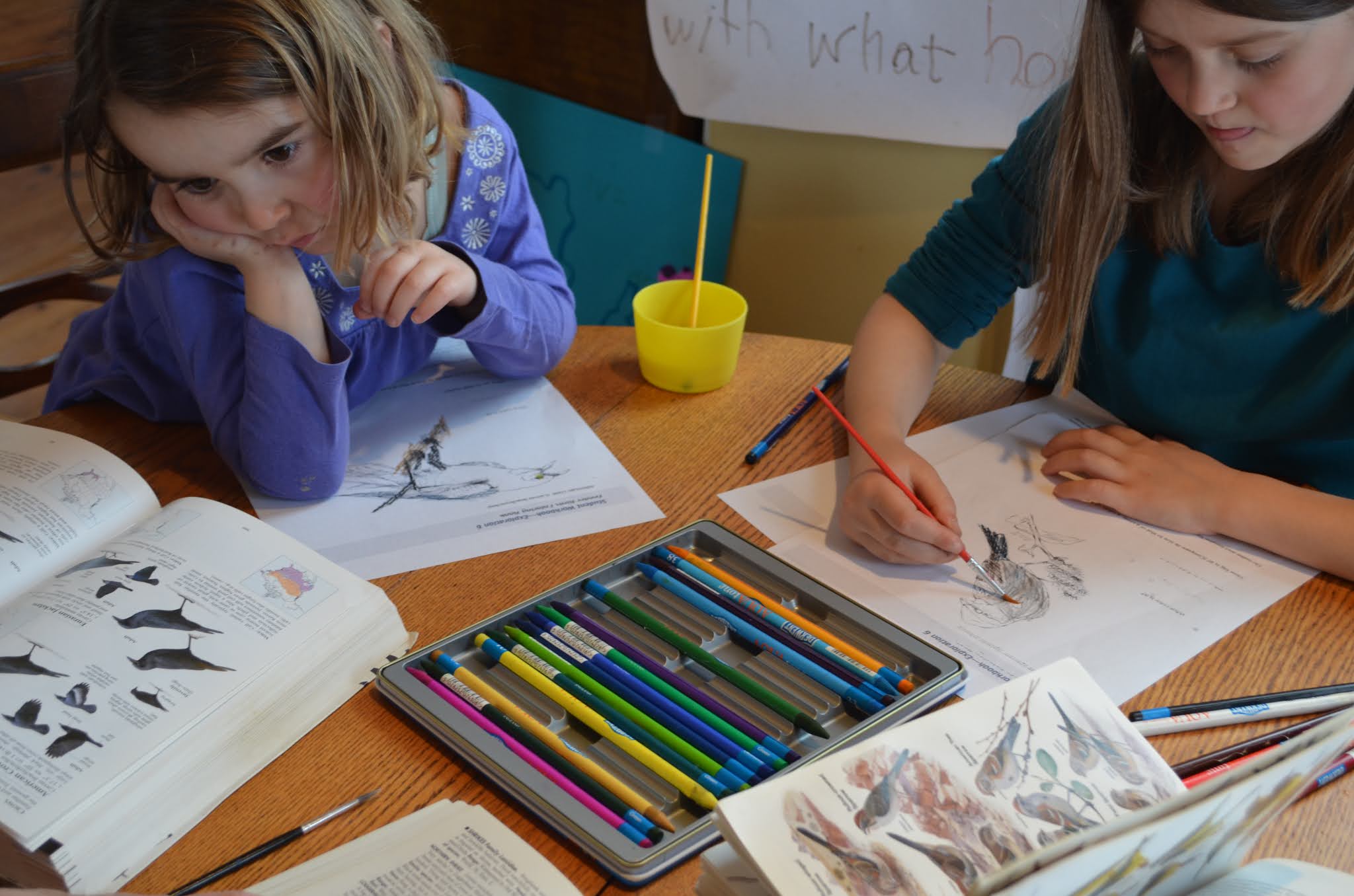
  • It's not too late to set up a bird feeder if you don't have one already.  Older children can make bird feeders from plastic jugs with the top half of one side cut out.  Use field guides to identify the birds that come to the feeder.  Keep track of preferred foods, beak design, and the way the birds eat their food.  Start a feeder journal and sketch the birds you see.
  • Do a Singing Bird Survey.  Have your child draw a map of your immediate neighborhood, showing main features such as buildings, roads, trees, playgrounds, streams, shrubs etc.  With the map walk around the area and listen for bird songs.  When one is heard, stop and mark the map with a letter, at the edge of the map write each letter and describe the song.  Continue on your survey using a new letter for each song.  Try to spot the birds that are singing.  Can you observe an individual bird singing from different spots?  Are there any birds listening nearby?  In early spring birds may still be in flocks not yet having split up to find territories and mates.  Return with your song map on subsequent days and see if the same songs can be heard in the same places, try different times of day.    credit:  Hands-on Nature, Vermont Institute of Natural Science
  • See if you can get a copy of the book Look Up! by Annette LeBlanc Cate.  It's a wonderful and inspiring resource for young birders.  My kids have it practically memorized!  "This conversational, humorous introduction to bird-watching encourages kids to get outdoors with a sketchbook and really look around. Quirky full-color illustrations portray dozens of bids chatting about their distinctive characteristics, including color, shape, plumage, and beak and foot types, while tongue-in-cheek cartoons feature banter between birds, characters, and the reader (“Here I am, the noble spruce grouse. In a spruce grove. Eatin’ some spruce. Yep.”).
  • Challenge older children to brainstorm as many questions as they can about a bird they see. Logging questions in a nature journal when outside can serve as a great launching point for research and inquiry when they are back inside and can consult books or the internet. The Cornell Lab of Ornithology at Cornell University is a wonderful online resource suitable for older learners or adults wanting to learn more in order to guide children's learning. Closer to home, our Wisconsin DNR has a great site to learn more about the feathered friends in our backyards and natural areas. 
  • When observing birds, ask children to consider all the ways birds are like humans (or other birds, animals, insects, etc.) and how they are different. Comparing and contrasting movement, communication, survival strategies, and adaptations can lead to interesting discussion and this exercise activates the important kind of thinking scientists use. 
  • Can humans make nests as well as birds can? Ask children to gather the kinds of materials birds might use and find a branch or spot to attempt to attach it. We encourage the use of natural materials so that the creation can biodegrade without harming the environment. More detailed resources for an nest engineering and design challenge can be found at PBS LearningMedia where there are also beautiful brief videos about the marvels of bird engineering. 
  • Movement! Try the Spring Sequence over at Kids Yoga Stories. Giselle Shardlow has done a fantastic job of creating resources for children and their caregivers. This is a great option for taking a movement break outside, if possible.
Parent Resources:
Great article on cultivating wonder: http://www.communityplaythings.com/resources/articles/2016/the-gift-of-wonder