Showing posts with label guest post. Show all posts

Monday, April 5, 2021

Celebrating Mud

 Guest Post by Julie Hoel, KVR Instructor and Enthusiastic Mud Loving Grandparent

I was just out of college and visiting a friend who had three children. We were chatting when her five-year-old son came bursting in the door full of boyish exuberance and covered with splotches of mud from head to foot. She took one look at him, put on her sternest mom face, whipped out her you’re-in-big-trouble-now voice and said, “JAY MEYER, HAVE YOU BEEN PLAYING IN THAT CREEK?” The smile fell from his face, he rolled his big brown eyes upward and said, “No.” The two older sisters and I tried our best contain our laughter as his mom began peeling off the muddy clothes and throwing them directly into the washer. To her credit, she did not shame him for being a muddy mess but continued with her harangue, “You know you’re not supposed to be playing in that creek!” Clearly, her concern was the danger of water play rather than dirty clothes. 

In these parts, we cannot escape the mud of the March thaw and April showers that follow. We can save ourselves irritation and frustration by just embracing and celebrating the wonders of mud. In that spirit, I would like to share my favorite holiday photo of all time. It was refreshingly different from the typical family photo of the kids clean and pressed. These parents were secure enough to celebrate their kids in all their mischievous muddiness in the deep green of a summer day.  When I recently asked their dad if I could share this image, he said, you’re “welcome to use that pic if it’s to promote kids being kids!” He added, “I think based on where we lived our kids naturally got real dirty experiencing being a kid in nature. We had 50 acres and a half mile of river frontage…what a place to be a kid!” He pointed out the nice clean laundry hanging on the line behind them. I also noticed that they are both wearing glasses that somehow remained relatively clear. Definitely experienced mudballs with some self-control!

In these two vignettes, the children sought and located the mud on their own. A quick google search will bring up many benefits of mud play including development of fine and gross motor skills, increasing cognitive skills and enhancing creativity. It also is good for the immune system and decreases stress levels. We would therefore be wise and wonderful caretakers to seek out opportunities for our children’s mud exploration. My favorite resource, Pinterest, has limitless schemes to bring mud play to every location. There are recipes for mud paint, fizzing mud and mud soup. The design suggestions for mud kitchens are endless.

But the fun of mud play is not just for children. Back in ’93, I experienced mud as art with adults during a volunteer week at Dr. Patch Adams’ Gesundheit! Institute in West Virginia. His model of good health includes humor and art as healing. Once a week, volunteers were encouraged to experience community in the mud pit. After the mud bath, there were photo sessions of numerous statuesque poses. It was a truly memorable experience!

So when you encounter the inevitable mud of the season, I encourage you remember your own fondest muddy memory and smile.  And if a mud-covered child comes bursting in your doorway, greet them with that smile and make throwing those dirty clothes into the washer a celebration.

P.S. All the above references to mud exclude flood mud.  That nasty stuff is a nightmare.

For some more muddy inspiration, check out these books and links:


 Mud by Mary Lyn Ray, Illustrated by Lauren Stringer

This beautiful book celebrates the beginning of the mud season in simple text and gorgeous illustrations. 


Mudplay for Kids: Why It's Worth the Mess - Healthline This article provides details about why messy play is so beneficial for children.

Mud, Marvelous Mud - Community Playthings With the benefits clearly outlined, this article provides ideas and considerations for embracing mud play with your child.

Monday, March 22, 2021

Spring Migration is Upon Us

 Guest Post by Barbara Duerksen

What a delight to welcome back the birds we have not seen for months! There’s music in the air – honking geese and calling swans flying to the northwest, robins, blackbirds, and cardinals singing in the morning, and the loud, rattling bugle calls of Sandhill Cranes.

Sandhill Crane photo by Dave Franks

When the ice goes out, the ducks come in. They might stay for a day, sometimes longer, as they make their journey from the southern states to their nesting territories.  A few of the duck species like Wood Ducks, Blue-winged Teal, and Mallards, stay in our area to raise their broods, while most of the other ducks head for farther north wetlands.  I find Hooded Mergansers particularly elegant and fun to watch. The males are black on top with white stripes in front and back, brown sides, and a black and white head that looks very large when the crest feathers are raised.  Females are brown and also have crest feathers that can be raised or lowered.  They look a little less elegant and more like a bad hair day.  I have found Hooded Mergansers in the Kickapoo Valley Reserve in early spring swimming in the wooded wetland at the junction of Hwy 131 and County P.

Hooded Merganser photo by Jack Bartholmai

Migration is all about food.  Waterfowl need open water to find fish, snails, worms, roots and other plant food.  Insect eaters need warm enough temperatures to find a good steady supply of insects, and that takes them far south of Wisconsin.  Seed eaters and some of the predatory birds can find enough food to get through the winter season, so we’ll see jays, chickadees, cardinals, crows, Cooper’s and Red-tailed Hawks all winter.  Juncos, American Tree Sparrows, Purple Finches, Rough-legged Hawks, and Northern Shrikes are among the species that come from way north to stay here for the winter.  They will be leaving soon, and instead we’ll see Fox, White-throated, and White-crowned Sparrows on their way north, in addition to other early migrants like kinglets and phoebes.

April brings some notable insect eaters, despite the possibility of cold weather and snowstorms. Hermit Thrushes, Yellow-rumped Warblers, and Winter Wrens are all insect eaters that seem to be able to withstand colder temperatures than others of their kind.  Their diets ae a bit more flexible –they prefer insects, but all three are able to digest fruits like juniper berries.  Cold spells with deep snow that last too long can be life-threatening to these birds, as we witnessed with in April, 2018.

Winter Wren photo by Dan Jackson

Winter Wrens are small brown birds with very short tails that they often hold upright.  They are smaller than the more familiar House Wrens that spend their summers here, and most of them fly farther north to the forests of northern Wisconsin and Canada. Winter Wrens have nested in cool microclimates in the Kickapoo Reserve and the Baraboo Hills, preferring areas with coarse woody debris or tangled roots. Some older field guides recommend looking for migrating Winter Wrens in stacks of firewood in the yard. On nesting territory, the male sings a loud, rich, lengthy, bubbly song.  You can listen to the song here by pressing the audio button.

The colorful familiar songsters like grosbeaks, orioles, and Indigo Buntings, will show up a bit later, some in late April and the rest in May, along with many migrating warblers. These are the long-distance migrants that spend the winter in warmer climates, some—Yellow Warblers and Barn Swallows, for example—as far south as countries in South America.

Migration is a perilous journey with hazards that range from bad weather and natural predators, to human-caused habitat destruction, window strikes, poisoning by pesticides, and predation by cats. How to help?  Study up on what birds need, support bird conservation groups and reserves (like the KVR), consider planting bird-friendly plants and trees in your yard.  The Cornell Lab of Ornithology has a list of suggestions here: athttps://www.birds.cornell.edu/home/seven-simple-actions-to-help-birds/

                                            American Woodcock photo by Jack Bartholmai

Ready for an evening adventure?  Go out at dusk to listen for the American Woodcock call and sky dance.  American Woodcocks are in the shorebird family, but nest on the ground in shrubby woodland edges. An odd-looking short-tailed brown bird, they are about robin-size, plump, with long beaks and eyes positioned high up and near the back of the skull. In early spring, the males, looking to attract a mate, find an open area to sit and call a series of single buzzy, nasal “peent” sounds, and after a while, fly up with a twittering sound in a large circle, descend to the same area with a slower chirpy sound, and start again to do the call. This occurs about 20 minutes after sunset. The open area around the Kickapoo Reserve Visitor Center has been a reliable spot to observe this spring ritual of the woodcock. 

For great reading on the woodcock dance check out these favorites:

Aldo Leopold, in A Sand County Almanac, describes the Sky Dance of the woodcocks on his farm in the April section of Part 1.  Frances Hamerstrom, in Walk When the Moon is Full, devotes her April chapter to the story of gong out with her two children to witness the sky dance of the woodcock.

Monday, March 8, 2021

Looking for Spring

  C. Chybowski

A guest post by KVR Educator Cathy Chybowski

Spring is in the air!  Even if the calendar says “March,” the cold winds blow, and the snow lingers, those of us tuned in to the changing seasons know that spring is fast approaching. By observing and recording natural events year after year, we can accurately predict and anticipate the sequence in which these events occur. 

The study of recurring natural events like the migration of birds or the flowering of plants and their connection with each other as the seasons change is called phenology.

Everyone practices phenology whether they realize it or not—naturalists, gardeners, farmers, and homeowners, among others. “April showers bring May flowers” is pure phenology.

Islay Pictures Photoblog

What tells you that spring has arrived? Is it the first robin of the year? Like Aldo Leopold, many people sense that spring has sprung when they see and hear a flock of geese flying in the typical V-formation proclaiming the change of season. 

 “One swallow does not make a summer, but one skein of geese, cleaving the murk of a March thaw, is the spring.”          

Leopold continues .  .  .  .  “A cardinal whistling spring to a thaw but later finding himself mistaken, can retrieve his error by resuming his winter silence. A chipmunk, emerging for a sunbath but finding a blizzard, has only to go back to bed.  But a migrating goose, staking two hundred miles of black night on the chance of finding a hole in the lake, has no easy chance for retreat. His arrival carries the conviction of a prophet who has burned his bridges.”

     Greg Gillson

 Sid Hamm

It is time to check last year’s phenology records for the order of events. We can predict that in southern Wisconsin, the red-winged blackbirds return to the marshes before the end of February and the bluebirds return to nest by March 15. The wood frogs begin their choral courtship the third week in March and ground squirrels and woodchucks emerge sleepy from hibernation by the end of March.  Hepatica begins to bloom around mid-April  and bloodroot blooms about one week later.

                                                                                                                                     awaytothgarden.com
                 C. Chybowski

Nature’s grand production runs from the time that skunk cabbage pokes up through the snow, through the time when the woodpeckers begin to drum, male red-wings “onk-la-ree” from the cattails and pussy willows fluff out. Killdeer and meadowlarks return, chipmunks awaken from their winter dormancy, song sparrows sing “hip hip hooray guys, spring is here,” balls of garter snakes appear, painted turtles pop up on sunning logs, mourning cloak butterflies and little brown bats flit about, and spring ephemerals emerge from the woodland floor.

   V. Charney

All of these observations were made before April 15th.  Soon thereafter the great wave of warbler migration begins (about a month after the woodcocks begin their aerial courtship display). Then the tree leaves burst forth, flowers in gardens and fields bloom and the air holds the sweet scent of lilacs just in time for Mother’s Day. The show continues on and on . . .

“During every week from April to September there are on average, ten wild plants coming into first bloom. . . No man can heed all of these anniversaries; no man can ignore all of them.”                                                                                                                                                       -   Aldo Leopold

No two years are exactly the same and some signs of spring are more reliable than others. Frogs are good predictors of spring. Wood frogs and spring peepers begin to sing soon after ice-out when the water has warmed to 46 degrees F. Earthworm castings become visible when the frost has come out of the ground. The return of robins and bluebirds is not a reliable indicator of spring because some of them stay in our area throughout the winter.

                                         petponder.com
            
Spring usually invades our state in the southwest corner and marches north and northeast at a rate of about fifteen miles a day. This was determined when residents across the state were asked to record the date at which the lilac, a species familiar to everyone, was in peak flower.

According to Hopkin’s law, phenological events vary at the rate of one day for each fifteen minutes of latitude, 1.25 days for each degree of longitude, and one day for each one hundred feet of altitude, being later northward, eastward, and upward. When applied in Wisconsin, this law seems to hold almost exactly along a north-south axis; except that Lake Michigan retards the spring warmup.

Above is merely a sampling of the discoveries that await the curious nature observer. It is a fun time of year for each of us to get outside and take a closer look at what Aldo Leopold calls the “hundred little dramas” happening right outside the door when spring is in the air. 

Tuesday, January 19, 2021

A Saunter for the Senses


A guest post by KVR Educator Chuck Hatfield.

It’s 3:30 PM as I stare out the window. The beautiful fairy-land of frost is gone, but the gray hills in the distance are robed in snow—warmed by the afternoon sun. I know these KVR hills.  They are miles away; steep and treacherous—covered in loose, new fallen snow and layers of slippery oak leaves. I used to be a hiker…no, John Muir disliked that word…I was instead a saunterer, one who “goes here and there” like a pilgrim in the “holy land.”  Then I had hip surgery, and my world got smaller. 

Recently I reread an article written 88 years ago this month by Helen Keller, a remarkable woman who was both blind and deaf. She wrote:

I asked a friend who had returned from a long walk in the woods, what she had observed. “Nothing in particular,” she replied.  How was it possible, I asked myself, to walk for an hour through the woods and see nothing worthy of note?

Healing, especially at my age, is frustratingly slow—bone and tissue first, with muscle and conditioning lagging, requiring a commitment to action. Snow shoveling was my commitment for the day. But I stare at a small notch of dark hemlocks, low on the hillside far away. I know that place! Its mysterious beauty, its haunting history, never fails to connect my soul to this amazing land. I am called...

In minutes I am following a wide, snowy trail, already packed by hundreds of boots. I turn off the main trail, finding my own path through the brush, now marked only by deer tracks.  It leads down into the steep valley where the ice-skirted Kickapoo River flows. As I cross the first small tributary, I stop to listen. The woods seem empty and I am expecting silence.  Not so. The wild cry of a pileated woodpecker echoes among the bluffs. A crow calls.  The river gurgles a response. Falling frost needles whisper past my ears.

I am now in a unique world where time has stood still—holding within it the spirit of the ice ages. When the last glacial ice sheet that surrounded the Driftless Area melted its way north, the sunny hillsides and ridges began a long transition to oak savanna prairies, mixed hardwood and pine forests.  But the steeply cut, moist, sandstone ravines—with cool, northern or eastern exposure—allowed a very special community of plants adapted to life on the edge of a frozen world to persist. 

Yellow Birch Bark
Blue Bead Lily

Partridge Berry


These microclimates contain the dark forests of hemlocks, interspersed with yellow birch, Canada yew, and eastern white pine, along with wintergreen, partridge berry, blue-bead lily, northern monkshood, and many other species that would normally be found hundreds of miles further north. 

In front of me a rocky, lichen-encrusted cliff thrusts itself into the river, seeming to block my passage beyond.  But I see that the deer tracks continue, and I know their secret.  A nearly invisible ledge of rock skirts the base of the bluff, providing a safe path to a wild and beautiful river woodland. Protected from human traffic by the river to the east and a wall of rock on the other, the snow is a newspaper of tracks and trails. All manner of animals, small and large, roam this marshy woods.  I stand for a while, absorbing the stories around me.  But, today I have a goal: the ice cave.


I reach a small valley that opens through the nearly continuous wall of rock. Only a careful gaze can see the bit of ice visible in a dark shadow above, not worth the effort to climb. Still, I hobble my way up to the shadow and find that the valley abruptly ends in a shallow half-circle cave. It is 5 to 20 feet in height  and 10 to 15 in depth, the whole cave being over 100 feet wide. 
Short but beautiful ice formations flank the sides, with several tall, magnificent ice columns gracing the center. It has the unsettling feeling of sacred space. I sit, my heart slows, and my senses reach out to explore…

Weeping sandstone, dripping in frozen lacework on the back wall…


The steady patter of falling water, a melody echoing from a hidden chamber within the column…


Pale blue-green light filtered through the icy veil…

The rattle of a small rock falling from the ceiling, the cluttered floor a witness to a process ongoing for thousands of years…

A feeling of safety and protection—a sense of history, of quiet ghosts of those who may have occupied this snug haven ages ago…

The heady smells of damp rocks, decaying leaves, of muddy soils…

Tracks of a small animal, barely visible in the twilight, leading to a dark hole in the far corner…

The ceiling, covered by the holes and impressions of 100s of fossilized Paleozoic worms…


The quiet, musical “clink” as I break off a tiny icicle, its melting coldness caressing my tongue….

I am enchanted by these lovely revelations and I admit that I seldom give my senses such full access to my conscious brain. Perhaps I have more worthy things to think about?  I continue to recall the words of Helen Keller: 

I who cannot see find hundreds of things to interest me through mere touch, feel the delicate symmetry of a leaf. I pass my hands lovingly about the smooth skin of a silver birch, or the rough shaggy bark of a pine. In spring I touch the branches of trees hopefully in search of a bud, the first sign of awakening Nature after her winter’s sleep. […and, even as I think of smells, my nose is full of scents that start awake sweet memories of summers gone and ripening fields far away].


Perhaps John Muir’s origin or definition of a saunterer was not accurate. Regardless, today I sauntered to this sacred place, bringing with me my greatest gifts—my senses.  And, it is awareness of these sensual moments that calls me to explore the world around me more fully, more intimately.  It is not just my healing leg that requires exercise!

Need a little food for your senses and rest from your emotions? Saunter along the river through the beautiful Kickapoo Valley Reserve and its sacred places; any day, any season, just do it!!

***

A note to our visitors...

We encourage everyone who hikes to the ice formations at the Kickapoo Valley Reserve this winter to be mindful of the fragility of the ice in a season that could see more traffic than usual as folks seek opportunities to get outside. Please remember that the Reserve's intent is to conserve, restore, and maintain the ecology and biodiversity of the Kickapoo Valley Reserve, while balancing access and recreation for visitors. Winter features like the ice formations are a part of this. Please avoid handling the ice and consider taking photos. We love to see photos shared on our social media pages. Thank you for being a part of the community that cares about the Kickapoo Valley Reserve and its many gifts. For more information, visit the Kickapoo Valley Reserve website and consult the Winter Trails Map.


Monday, November 23, 2020

Animals Toughing It Out: Resisting the Stresses of Winter to be Active, Part 2

                                    Guest post by KVR Instructor, Cathy Chybowski

            Photo of Ruffed Grouse Courtesy of EEK! Wisconsin: Environmental Education for Kids eekwi.org                                 
Like animals that migrate or hibernate, animals that are active in the winter have evolved key adaptations that help them avoid or confront harsh conditions. An adaptation can simply be making use of fur, fat, or feathers. Mammals grow heavy undercoats and long hollow guard hairs to trap air for better insulation. Birds can fluff out their feathers or tuck their heads under their wings for warmth. A grouse spends the day foraging and filling its crop with food. Then it dives or burrows into deep snow, slowly digesting its food, warm beneath a blanket of snow.  

Animals living farther north tend to have larger bodies and smaller appendages. A large body loses heat more slowly than a small body. Shorter appendages radiate less heat than longer ones. Many animals living in the north turn white in winter. The obvious advantage is camouflage for both predator or prey. But another advantage is that white feathers and fur contain more air than pigment so provide better insulation than fur or feathers with color. In summary, it is better to be big and white in winter. Think polar bear! It has a large body, short ears, tail and legs, and white fur. It is perfectly adapted for living in a cold, snowy landscape.

Snow is a mixed blessing. For small mammals like voles, it can provide both insulation and protection from predators. For animals like deer, it can make travel difficult.

The meadow vole, sometimes called a field mouse, spends most of the winter under the snow in a system of tunnels leading to a communal nest. It is an exception to the “better to be big and white” rule.

Photo of Meadow Vole courtesy of EEK! Wisconsin: Environmental Education for Kids eekwi.org 

To compensate for its small size and brown color, it actually loses weight before winter in order to reduce its need for food. Because it is an important part of the food web, it seldom ventures above the snow. Still, foxes and coyotes hear voles moving under the snow, jump up and down to collapse their burrows, trapping them and then retrieving them. Two to three months before the snow has melted, still snug and protected, voles begin to reproduce. A young female can mate at one month of age and produce as many as 17 litters per year with 5 or more young per litter. Look for the tracks of these small mammals on top of the snow or the quarter-sized entrance holes to their tunnels beneath the snow. As the snow melts, the topless tunnels reveal well-traveled runways beneath.

The white-tailed deer is an energy conservation specialist. Whenever possible, it does not expend more energy than it takes in. It grows a thick, woolly underfur and an outer fur with long hollow guard hairs for insulation and it relies on fat reserves built up in the warm months to fuel its activities in the winter. When the snow is deep, deer yard up and follow well worn paths to evade predators and conserve energy. Their digestive system changes to accommodate a change in diet—grazing in the warm months to browsing in the winter months due to the snow cover. When you are outside, look for deer browse, tracks, scat, beds, buck rubs, or antlers usually shed in late winter.

Photo of White-Tailed Deer Courtesy of EEK! Wisconsin: Environmental Education for Kids eekwi.org 

As a group, birds face three obstacles to winter survival: cold temperatures, starvation, and predation. Birds have a higher metabolic rate and a higher body temperature than mammals, therefore making surviving the cold more difficult.The food supply is diminished and often unreliable. Snow can limit access to otherwise available food.  Predators are ever present.  Small birds like chickadees, nuthatches, kinglets, brown creepers and titmice join mixed flocks. More eyes reduce the possibility of a predator attack and broadens the search for food. Sometimes these flocks even roost together in a tree cavity, bluebird nest box, or other shelter. Some birds like blue jays, chickadees and nuthatches store food for later consumption and many birds frequent our feeders when the weather turns harsh or there is deep snow cover.

The black-capped chickadee is another exception to the “better to be big and white” rule. In order to maintain its body temperature in winter, it requires 20 times more food than in the summer.  How do they do it? Among the chickadee’s amazing physical feats is its ability to forage while hanging upside down and moving every which way, foraging for eggs and larvae of insects in bark crevices. Could this acrobatic method be an adaptation for winter feeding when snow covers the tops of branches, chickadees can still gather food from beneath?

Photo of Black-Capped Chickadee courtesy of EEK! Wisconsin: Environmental Education for Kids eekwi.org 

Unlike mammals, birds do not grow extra feathers for warmth in the winter.  Instead, they fluff their feathers to trap more air for added insulation, often tuck their heads under their wings, and huddle together under an evergreen bough with a snowy canopy.  

Aldo Leopold writes in A Sand County Almanac: “I suspect that in the chickadee Sunday School two mortal sins are taught: thou shalt not venture into windy places in winter, thou shalt not get wet before a blizzard.” Apparently a chickadee survives a frigid 16-hour night by doing lots of little things just right. As these tiny creatures wake with the sunrise, they begin foraging and this becomes the order of their day. By late afternoon they are “bulging with fat” which provides insulation. As the sun sets they lower their temperature as much as 15 degrees, settling into a nightly hypothermia, fluffing, tucking, and huddling till sunrise again, when the fat is depleted. Repeat. Repeat every 24 hours; it is a matter of survival. When you are out, listen for the chickadee’s voice and watch for their quick movements.

The next time you reach to turn the thermostat up, think about the challenges that animals face for winter survival and some of the amazing adaptations and strategies they have evolved to deal with them.

***


We love the resources at EEK! Wisconsin, Environmental Education for Kids. They are hosting a live reading on December 2, 2020, at 10 AM CT, by author Laureanna Raymond-Duvernell from her book,
 Under the Mud, about 10 different animals and their winter survival adaptations. For more information or to register visit https://www.eventbrite.com/e/story-edventure-read-aloud-under-in-the-mud-tickets-127366770439 This event would be great for students in grades 3-8, and it is free. Educators are encouraged to register for their classes. Homeschooling and schooling-at-home families might enjoy this, too!

Wednesday, November 18, 2020

How do they do it? Part 1


Guest post by KVR Instructor, Cathy Chybowski

As the days become shorter and the temperature drops, animals have three options in order to survive: migrate, hibernate or remain active. These strategies along with essential adaptations help animals to survive the cold season.   

 photo credit: freepik.com

Migration: An Easy Out?

Migration can be quite risky. The energy cost of migration is high and there can be many obstacles along the route. Most animals spend time in a feeding frenzy prior to migrating. This added fat will fuel their movement to an area with sufficient food. For hummingbirds, warblers, flycatchers and other birds that lose their food source with the onset of winter, migration is a necessary risk. Large bodies of water, a changing food supply, predators or hunting can make the trip challenging.

Did you ever wonder why it is mostly birds that migrate? Why so few mammals? According to Peter Marchand in his book, Life in the Cold, a mammal would expend ten times more energy moving a given distance by running than would a bird of equal weight flying that same distance. Bats and caribou are exceptions. For more information on bats and insects that migrate see a previous post I shared in August.

Hibernation? Dormancy? What is the difference?

Dormancy is one of the three strategies animals evolved for winter survival. It is a period of inactivity in which an animal’s bodily functions are slowed down. By definition, hibernation is an extreme form of dormancy. Woodchucks, bats and jumping mice are among the few mammals in our state to hibernate.  

 photo credit: WI DNR

As an herbivore, the woodchuck’s life is centered on the availability of plants. Feeding heavily during late summer into fall, it accumulates thick rolls of body fat and then retires to its burrow usually by the end of October. While hibernating, its heart rate drops from 75 beats to 4 beats per minute, its body temperature drops from 90 to 38 degrees, and it breathes once every 5 to 6 minutes. If the woodchuck can maintain this state of low metabolism for several months without freezing to death, it will usually emerge from its burrow during the first week of March (not like Punxsutawney Phil on Feb. 2). 

There are degrees of dormancy, from the true hibernation of the woodchuck at one extreme, to the deep sleep of bears and chipmunks, and to the short term sleep of skunks, opossums and raccoons. In all forms of dormancy, the metabolism slows down in order to conserve energy at a time when food is scarce.

   photo credit: bearstudy.org

Research shows that the black bear does not hibernate; its body does not undergo the drastic changes of a true hibernator. In order to prepare for its deep winter sleep, bears spend the fall in a feeding frenzy putting on several inches of body fat and growing a thicker fur. While in the den, the sow gives birth to 2-3 cubs which do not hibernate either. During this state of dormancy, the bear does not eat or drink, it does not produce waste and it does not lose bone or muscle mass despite the lack of exercise. How do they do it?  These unique adaptations are of interest to medical science. There is more to learn about black bears—how is it that they can survive a 5-month rest and fast and emerge from their den with a 99% survival rate?  Apparently there are few people willing to crawl headfirst into an active bear den in the winter to see just how cozy everything is in there!

    photo credit: WI DNR

Chipmunks spend much of the fall collecting seeds and nuts for storage in their underground burrow where they spend most of the winter in dormancy. The stored food gives them the option of waking and being active for a time; I was surprised to see a chipmunk out and about during a January thaw. No true hibernator could do this.

  photo credit: WI DNR

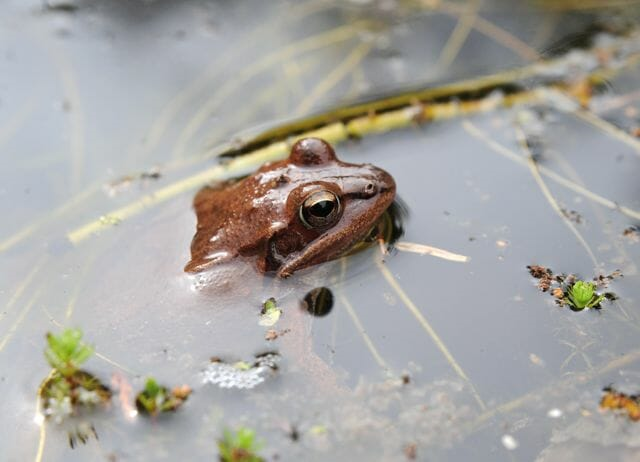
Unlike mammals, reptiles and amphibians are cold-blooded. Their options for winter survival are few. Since their body temperature drops with the outside temperature, they will freeze to death if they do not hibernate or go dormant in some form. Most frogs and turtles hibernate in the mud at the bottom of the pond or lake. Wood frogs are an exception, burrowing under damp leaves and into the soft soil of the forest floor. The wood frog produces an antifreeze which prevents its cells from freezing. Much of the body fluids outside the cells will freeze as will the frog’s eyes and brain. Its heart and lungs will stop. This “frogsicle” looks lifeless, but with the arrival of spring, it thaws quickly and is the first frog to emerge from hibernation. It is no wonder that the first frog we hear calling in the early spring is the wood frog. When the ice recedes and the water warms to 46 degrees, these frogs begin to call for a mate.

Snakes, cold-blooded reptiles, generally hibernate in dens or burrows of other animals, sometimes in groups of mixed species.  These are called balls of snakes and it is an amazing thing to see in the spring as these reptiles emerge from their hibernaculum. I witnessed dozens of garter snakes emerging this way one time in southeastern Wisconsin. I happened to be in the right place at the right time.

Stay tuned for Part 2, Animals Toughing It Out, in the weeks to come!

Monday, October 26, 2020

Fall Bird Migration: Sighting, Care and Feeding

 Guest post by Barb Duerksen, KVR Instructor 

Ruby-crowned Kinglet. Photo by Jack Bartholmai.

It’s fall and birds are on the move. Cold weather means fewer insects, so the birds that depend entirely on insects for staying alive must migrate–they fly south to find enough to eat.

October and November are exciting months for people who enjoy seeing birds that are flying in from farther north. Some are species that we can find only during the time of migration. 

The Ruby-crowned Kinglet is a migrant that I’ve seen along the roadsides recently. They are olive-colored with white wing bars and a white eye ring. They are small and energetic, flying quickly through the shrubs, weeds, and trees, searching for food and flicking their wings almost constantly. In fall the kinglets are quiet, except for a soft two-noted “jidit” call. The ruby-colored spot on top of the male’s head is usually hidden in fall. When they come back through in the spring, the males display that bright red spot, and sing a sweet warbly song. (Listen to the song and call here by clicking on the Audio button.) Most Kinglets will be gone by the end of October. They will spend the winter in the southern United States and Mexico.


Tundra Swan. Photo by Dan Jackson.

Waterbirds are another group of birds that migrate. They live on or near water, so when it gets cold enough for the water to freeze, they fly south to warmer places. Late October through November is a good time to find geese, swans, and many different species of ducks on ponds and rivers. Tundra Swans are huge white birds with long necks that nest in the far north Arctic tundra. When the weather turns cold, many of them fly south and east, some stopping at resting places like the Mississippi River for a time while they tank up for the rest of the flight. Many spend the winter in the Chesapeake Bay area on the east coast. Goose Island and south along the Mississippi River are good places to find hundreds of these swans in November and sometimes into early December, depending on when freezing temperatures arrive. They call constantly during migration, a high musical “hoo hoo” sound. When you hear that, look up, and you’ll see a flock of big white birds heading south east. Sometimes they migrate at night. (Listen to their call here by pressing the Audio button.)


Dark-eyed Junco. Photo by Dan Jackson.

The birds that can stay alive eating seeds don’t need to leave when the insects disappear. They can usually find food all winter. These birds stay here year-round and are appropriately called resident birds. Black-capped Chickadees, White-breasted Nuthatches, cardinals, Blue Jays, goldfinches, some sparrows, and many of the woodpeckers are residents who stay here through the winter. Some birds like Dark-eyed Juncos and Purple Finches fly here from the north and stay for the winter. Putting up a bird feeder in the yard is a good way to enjoy the familiar birds and learn about the new species that arrive for the winter. Birds do have a harder time finding food when there is lots of snow on the ground and it gets very cold. It is important when there is nasty weather to keep the feeders full. 

Here are some things to consider when you set out to feed birds:

Placement: Keep the feeder within 3 feet or farther than 30 feet from your window to avoid birds crashing into the window.

Cover: Put the feeder near some cover, so the smaller birds have a place to hide when predators come along. If you put a post in the ground near the feeder now before the ground freezes, you can tie your used Christmas tree to the post

Sanitation: Keep your feeders clean so birds don’t get diseases.

Safety/Predators: If you live where there are lots of outdoor cats, it’s really not a good idea to put up a feeder.

For more information about feeding birds: Visit Cornell Laboratory of Ornithology’s All About Birds site.  

What to feed the birds?  A simple way to start is to put out black oil sunflower seeds and a suet feeder. Most of the birds we have here in the winter like the sunflower seeds.  Woodpeckers especially like suet. You can buy suet blocks at the feed stores, or raw suet from a meat locker. You should only use the raw suet when the weather is cold, as it can get messy and turn rancid in warn weather.


Red-bellied Woodpecker. Photo by Dan Jackson.

Here are some birding activity ideas to inspire you to get out as we move through the fall season.

  • Spend a little time outdoors on a walk or sitting still. Listen for bird calls. If you hear chickadees, look nearby for other species. Sometimes migrant birds follow the chickadees on their feeding routes. 
  • After the leaves are gone and before there’s snow on the ground, the world can seem drab and gloomy. Maybe it’s time to celebrate drab. Bundle up, go out, find 10 things that you would consider drab, and take another look.